Hà Khê hill, west of the city
Thiên Mụ Pagoda
The oldest surviving pagoda in Huế, set where the Perfume River bends.
The story
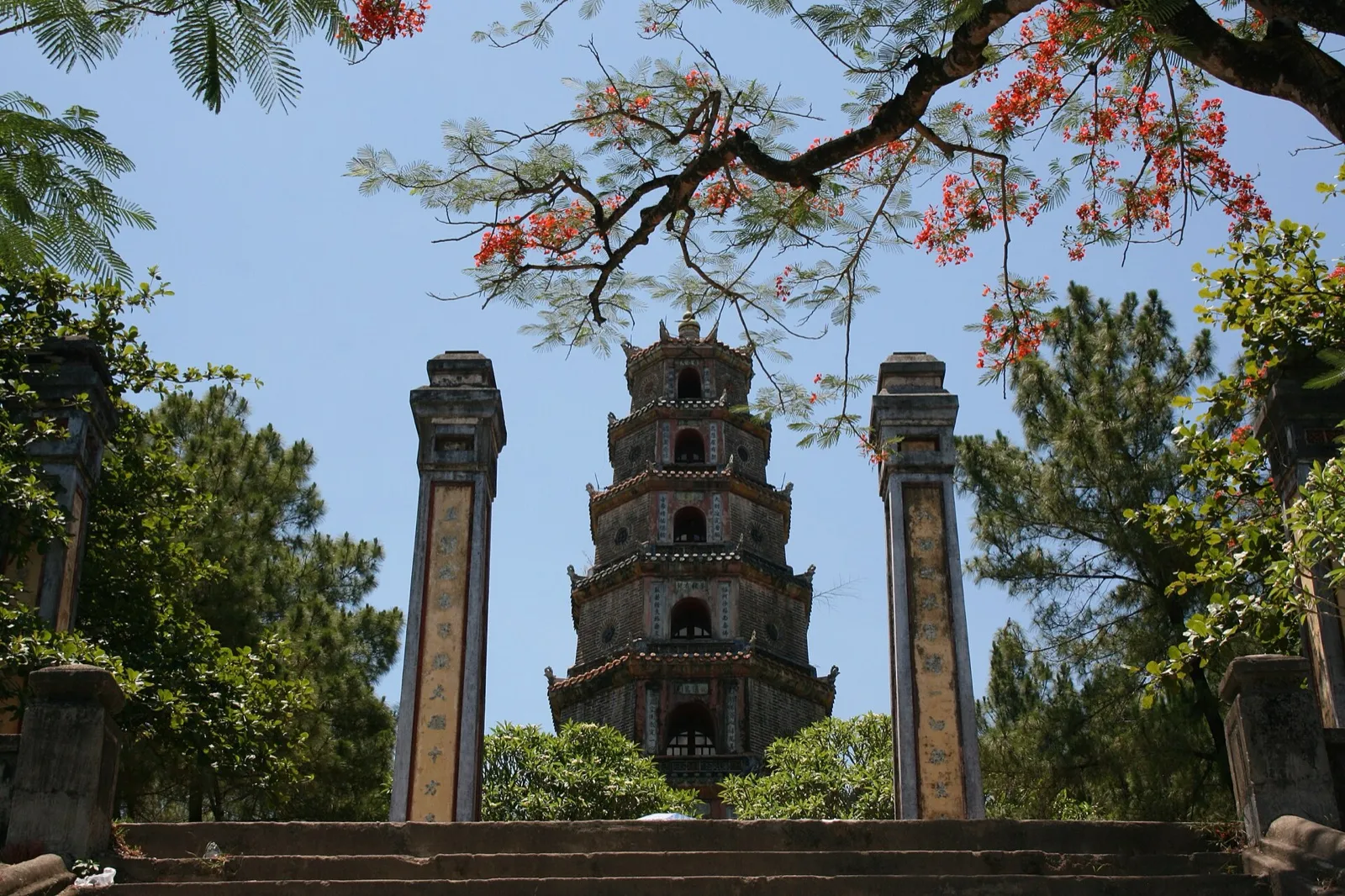
Coming up the road to Hà Khê hill, the seven-tiered Phước Duyên Tower appears first, like a landmark pointing the way. Thiên Mụ Pagoda stands here, about five kilometres west of central Huế, facing the Perfume River. In front are four tall pillars; nineteen stone steps lead up to the courtyard. The tower is 21 metres high, octagonal in plan, built in 1844 under Emperor Thiệu Trị for the 80th-birthday celebration of Empress Thuận Thiên Cao, the emperor's grandmother. Each tier holds a Buddha.
The name comes from a legend. Locals say that night after night an old woman in a red blouse and green skirt appeared on the hill and spoke: one day a true lord would come and build a pagoda here to gather the land's energy and keep its dragon vein strong. Then she vanished. When Lord Nguyễn Hoàng took charge of Thuận Hóa, he heard the story, had the pagoda built in 1601 and named it Thiên Mụ — the lady of heaven. The pagoda is also called Linh Mụ. The legend needs no proof to show how deeply it has settled into the way Huế names this land.
The pagoda has been restored many times. In 1665 Lord Nguyễn Phúc Tần had it repaired; in 1710 Lord Nguyễn Phúc Chu had a great bell cast, 2.5 metres tall and 3,285 kilograms; in 1715 he had a stone stele raised on a marble turtle's back. The emperors Gia Long, Minh Mạng, Thiệu Trị and Thành Thái all ordered repairs. The pagoda was badly damaged in 1943; from 1945 the monk Thích Đôn Hậu led a restoration that lasted more than thirty years.
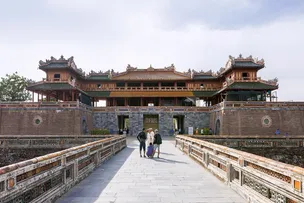
Walk up into the courtyard, then turn your back on the tower. Below, the Perfume River bends and boats cross. Through the triple gate, the upper floor honours Lord Nguyễn Hoàng and Bà Mụ. In the garden behind the main hall is the car of the monk Thích Quảng Đức, kept from before his self-immolation in 1963 to protest the persecution of Buddhism. People come here to pray, to look, and to stand still for a while — all three are right here. On the way down, walk slowly past the worship halls. This is still a working temple, not a museum.
What to look for
- Phước Duyên Tower: seven tiers, 21 metres, octagonal, built in 1844 for Empress Thuận Thiên Cao's 80th birthday.
- Four tall pillars and nineteen stone steps from the road up to the courtyard.
- The courtyard view down to the Perfume River: the bend, the boats crossing.
- The car of the monk Thích Quảng Đức in the garden — kept from before his self-immolation in 1963.
Getting there & etiquette
- Go early morning or late afternoon; midday sun is harsh.
- 30–45 minutes is enough, but sitting by the river takes longer.
- Keep quiet around the worship halls; cover shoulders and knees.
- It is still a working temple — ask before photographing people at prayer.