North bank of the Hương River
The Imperial City
A miniature ceremonial city of the Nguyễn court: every wall and gate is a step in the order of power.
The story
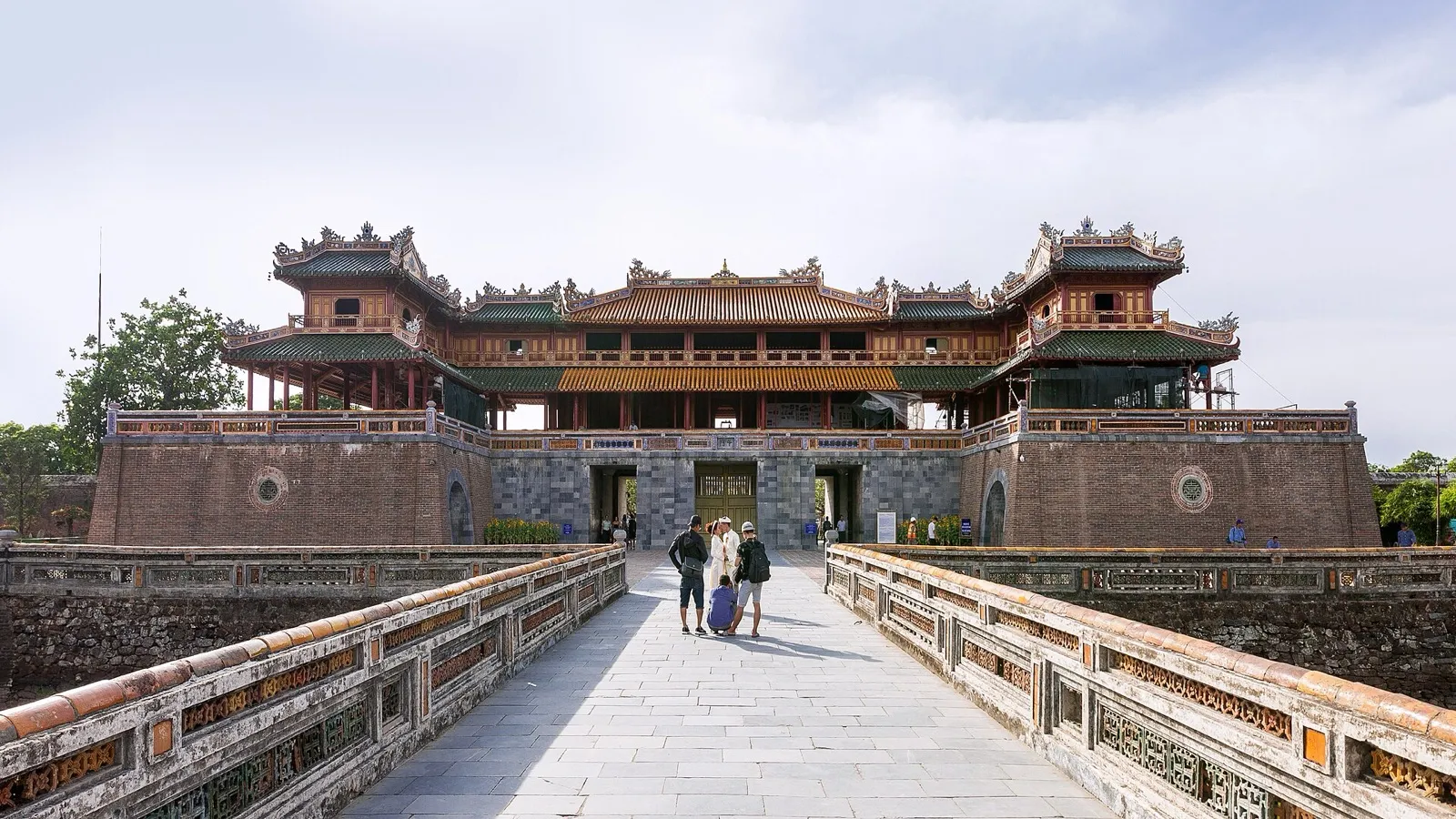
You are standing at Ngọ Môn, the main gate facing the Perfume River. It was built in 1833 under Emperor Minh Mạng in place of the older Nam Khuyết Đài, and it keeps its shape today: a U-shaped platform almost five metres high, topped by the two-storey Ngũ Phụng Pavilion with a hundred lim-wood columns and nine sets of yellow and green glazed-tile roofs. The platform has five passages, not three. The central one, Ngọ Môn, was for the emperor; the next two, Tả Giáp Môn and Hữu Giáp Môn, for civil and military mandarins; the two outermost, Tả Dịch Môn and Hữu Dịch Môn, for soldiers, horses and elephants. People called this arrangement “minh tam ám ngũ” — three visible, five in fact. The gate stayed shut most of the year, opening only for the emperor's processions or important envoys.
This gate opens onto three layers of a capital. The outer ring is the Citadel, home to officials and residents; inside it the Imperial City, where the court governed and made offerings; deepest is the Forbidden Purple City, once reserved for the emperor and those who served him. Huế was the capital of a unified Vietnam from 1802, and the Nguyễn dynasty held that role until 1945. The citadel faces the Perfume River with Ngự Bình Mountain as a screen in front, and hills on either side likened to a blue dragon and a white tiger. Each work was placed by the five elements and five colours — the old builders set a capital into the land the way you would place a house.
Walking further in, you pass the Thái Hòa Palace. Gia Long had it built in 1805; Minh Mạng rebuilt it on this site in 1833. Coronations, great audiences and receptions for envoys took place here. After more than two centuries it was restored and reopened in early 2025, its red-and-gold ornament reworked by hand. Don't stop at the main courtyard: look at the rows of columns, the stone floors, the doorways on either side. Then look at the empty spaces between the halls. Three wars passed through here; many buildings of the Forbidden Purple City lie in ruins, and restoration continues with traditional techniques and materials. Those gaps are part of the story — they show the scale of a capital that once was.
In 1993 the Complex of Huế Monuments was inscribed as a World Heritage site under criterion (iv): an outstanding example of an eastern feudal capital. So as you leave, remember this: what tells the story best here is not the signboard, but the bricks, the doorways and the columns you just walked past.
What to look for
- Ngọ Môn: five passages — centre for the emperor, next for mandarins, outermost for soldiers, horses and elephants.
- Ngũ Phụng Pavilion: 100 lim-wood columns and nine roof sets on a U-shaped platform.
- Thái Hòa Palace: built in 1805, rebuilt in 1833; the setting for coronations and great audiences.
- The empty spaces between halls: many Forbidden Purple City buildings lie in ruins after three wars.
Getting there & etiquette
- Go early, before about 9am: less sun and fewer groups.
- Allow at least 2–3 hours; bring water and a hat.
- Dress respectfully around the worship halls: shoulders and knees covered.
- Tickets and opening hours change by season — ask at the gate or check the official site beforehand.