Thuỷ Xuân, south of the city
Tomb of Tự Đức
The tomb of a poet-emperor, built as a retreat as much as a burial place.
The story
You enter through the gate and follow the path around the lake. The first thing that strikes you is not a tomb but a garden: pines, water, and buildings set out according to the lie of the land. The tomb of Tự Đức lies in a narrow valley in Dương Xuân Thượng village, now Thủy Xuân ward, about eight kilometres from central Huế.
Tự Đức was the fourth emperor of the Nguyễn dynasty, reigning from 1847 to 1883 — thirty-six years, the longest of them all. He began the tomb in 1864 with fifty thousand soldiers at work. It was first named Vạn Niên Cơ; after the Chày Vôi uprising the emperor renamed it Khiêm Cung, and only after his death did it become Khiêm Lăng. The work was completed in 1873. Nearly fifty structures here, across both the temple precinct and the burial precinct, carry the word khiêm in their names — from Vụ Khiêm gate and Khiêm Cung Môn to Lưu Khiêm lake and Hòa Khiêm hall.
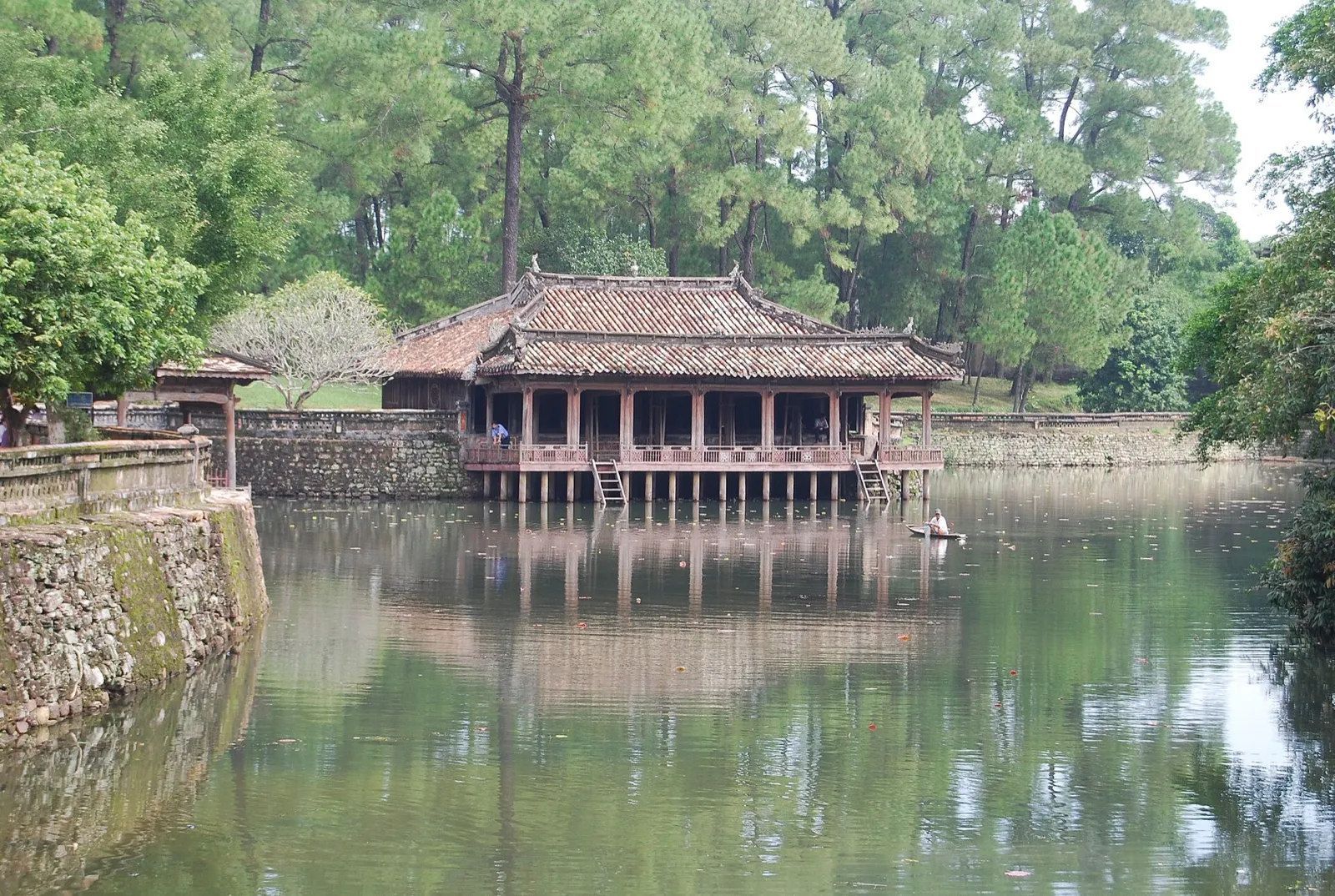
You walk through it not to visit a grave, but to understand how an emperor wished to be remembered. He used the place as a retreat to read and write poetry before it became his burial place. Two pavilions stand on the water, Xung Khiêm Tạ and Dũ Khiêm Tạ: one where the emperor sat in the breeze and wrote verse, one a boat landing for his outings on the lake. Minh Khiêm Đường is the oldest of the four Nguyễn court theatres and the only one inside a tomb complex. The Khiêm Cung Ký stele carries 4,935 Chinese characters — more text than any other stele in Vietnam, and the only one an emperor wrote for himself; in 2015 it was recognised as a national treasure.
Next to Khải Định's tomb, this one feels light and open. Walking it properly takes about an hour — and it deserves the time, because the pleasure lies in the distance between buildings, not only in each one. Before you leave, stand by the lake once more. A poet-emperor chose this place to rest — it still keeps that quiet.
What to look for
- Lưu Khiêm lake and the two pavilions on the water: Xung Khiêm Tạ and Dũ Khiêm Tạ.
- Nearly fifty structures in the tomb — every name carries the word khiêm.
- Minh Khiêm Đường: the oldest of the four Nguyễn court theatres, the only one inside a tomb.
- The Khiêm Cung Ký stele: 4,935 Chinese characters, the only stele an emperor wrote for himself.
Getting there & etiquette
- Go in the morning; there is shade but still plenty of sun.
- Allow about an hour, longer if you like photographing.
- Keep quiet around the tomb area; do not climb on the structures.
- The approach can be busy at weekends — earlier is easier.