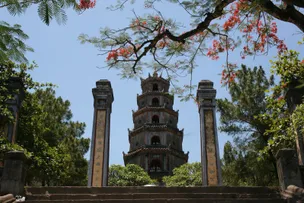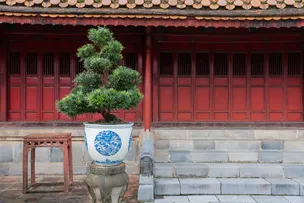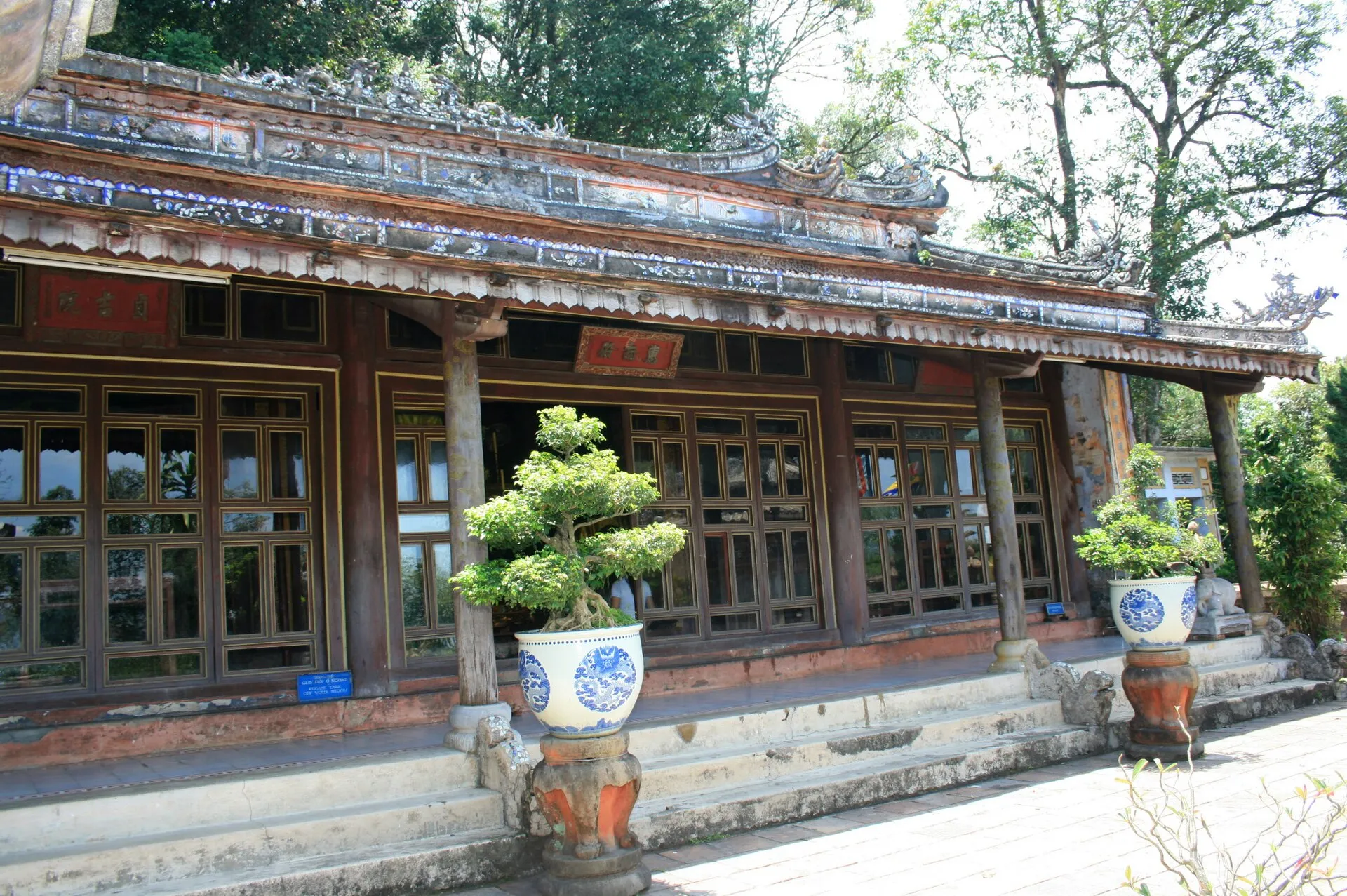
Ngọc Trản hill on the south bank of the Hương River
Hòn Chén Temple
A small river hill where Cham and Vietnamese beliefs meet: the temple of Mother Goddess Thiên Y A Na, whose “younger brother” was once an emperor.
The story
You come by boat to the landing below Ngọc Trản hill, or by road around the slope, then climb narrow stone steps to the temple. Behind you is the Perfume River; ahead are temple roofs scattered across the south-east slope under the trees. Near the summit the hill has a hollow that fills with rainwater and looks like a jade cup — hence the name Ngọc Trản, the “jade cup”, which people call Hòn Chén.
The story here is older than any one dynasty. Before the Vietnamese arrived, this was a place where the Cham worshipped the goddess Pô Nagar. Later, Vietnamese followers of the Thiên Tiên Thánh Giáo continued to worship her as Mother Goddess Thiên Y A Na. From 1954, Princess Liễu Hạnh was also installed here; the temple additionally honours the Buddha, Quan Công and more than a hundred other deities. You see it as soon as you enter: no single god stands at the centre, but layer upon layer of belief.
In 1832 Emperor Minh Mạng had the temple repaired and enlarged; two years later it was restored again. In 1883–1885 the mother of Emperor Đồng Khánh came to Ngọc Trản to pray and ask the Mother Goddess whether her son would take the throne. After he did, in 1886, Đồng Khánh had the temple rebuilt more grandly, added ritual vessels and renamed it Huệ Nam Điện — “grace bestowed on the southern country”. According to the official tourism record, the emperor also elevated its annual ceremony to a national rite and declared himself a disciple of the Mother Goddess, addressing her as “elder sister”. An emperor standing below a sacred mother, on a hill above the river.
About ten structures stand on the slope. The main sanctuary is Minh Kính Đài, built in 1886 on a plan of 15 by 17 metres and divided into three halls: the upper hall honours Thiên Y A Na, Mother Goddess Vân Hương and a portrait of Đồng Khánh; the middle hall holds the regalia carried in processions; the front hall has the altar, drum and bell. On the roof ridges, the phoenix appears again and again — a symbol of women, and here of the goddesses themselves.
On ordinary days the temple is quiet and you can sit on the steps above the landing. On the 2nd and 3rd of the third lunar month (the Mother's death anniversary) and in the seventh lunar month (the Father's), the festival runs for two days: people arrive with offerings from three or four in the morning, dragon boats crowd the Tòa Khâm landing below the temple, and a procession carries the Mother Goddess from Huệ Nam to the village hall of Hải Cát. As you leave, remember: this temple belongs to no single religion and no single dynasty. It stands here because many people, across many centuries, needed somewhere to ask for help.
What to look for
- The stone steps from the river landing up to the temple, looking back over the water.
- Minh Kính Đài (1886), 15 by 17 metres, in three halls: upper, middle and front.
- Phoenix figures on the roof ridges, emblems of the goddesses.
- The portrait of Emperor Đồng Khánh in the upper hall, beside the Mother Goddess.
Getting there & etiquette
- You can arrive by boat on the Perfume River or by road; the stone steps are fairly steep.
- Festival days are crowded — come on a weekday for quiet.
- Dress respectfully in the temple: shoulders and knees covered.
- Opening hours vary — ask ahead if you plan to visit outside daylight.