Cẩm Kê mountain near Bằng Lãng junction, about 12 km from the centre
Tomb of Minh Mạng
Some forty structures laid out on three parallel axes: Nguyễn tomb architecture at its most strictly symmetrical.
The story
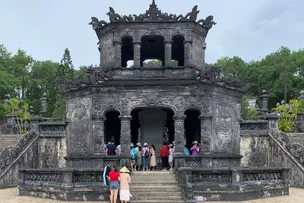
You stand before Đại Hồng Môn, the main gate of Minh Mạng's tomb, and notice something odd at once: the gate has three passages, but the central one is hardly meant for you. According to Vietnam's National Tourism Administration, the main gate opened only once, to carry the emperor's coffin into the tomb; afterwards people came and went through the Tả Hồng Môn and Hữu Hồng Môn side gates. Above the gate rise 24 roofs at different heights. From the first step, the place tells you it is arranged, not a garden for strolling.
The tomb stands on Cẩm Kê mountain near the Bằng Lãng junction, where the Tả Trạch and Hữu Trạch streams join to form the Perfume River, about twelve kilometres from central Huế. In April 1840 Minh Mạng renamed the mountain Hiếu Sơn and called the tomb Hiếu Lăng. Work began in September 1840. In January 1841, with construction unfinished, the emperor died; his successor Thiệu Trị continued from the original design. In August 1841 the coffin was placed in Bửu Thành, and the tomb was completed in 1843. Some forty structures, large and small, are arranged on three parallel axes, with the Thần Đạo — the spirit path — down the centre.
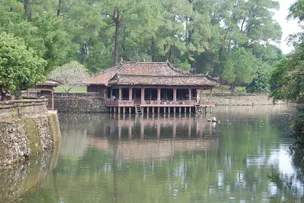
You cross a wide courtyard lined with mandarin, elephant and horse statues, then reach the Bi Đình on Phụng Thần Sơn hill. Inside stands the “Thánh Đức Thần Công” stele, written by Thiệu Trị about his father. Beyond are Hiếu Đức Môn, the Sùng Ân hall — where the tablets of Minh Mạng and Empress Tá Thiên Nhân are worshipped — and Hoàng Trạch Môn. Three bridges, Trung Đạo, Tả Phụ and Hữu Bật, cross the Trừng Minh lake to Minh Lâu, a square, two-storey, eight-roofed pavilion on Tam Đài Sơn hill. Behind it, two flower gardens shaped like the character for longevity face each other across the path.
The last stretch is where you should linger. The crescent-shaped Tân Nguyệt lake wraps around the circular Bửu Thành; across the Thông Minh Chính Trực bridge and up thirty-three stone steps lies the emperor's resting place on Khai Trạch Sơn hill. You can walk the central axis, but try standing off to one side: the whole complex appears as a floor plan folded in half, every structure paired with its mirror.
Minh Mạng died before the tomb was finished. What he left was an order already drawn, and his son built it exactly as drawn. As you leave, remember: the beauty here is not in any single detail, but in the fact that everything knows where it must stand.
What to look for
- Đại Hồng Môn: three passages and 24 roofs; the central one opened only once, for the coffin.
- The Bi Đình and its “Thánh Đức Thần Công” stele, written by Thiệu Trị about his father.
- Three parallel axes with the Thần Đạo in the centre; some forty structures in all.
- The crescent Tân Nguyệt lake around Bửu Thành, and 33 stone steps up to the emperor's grave.
Getting there & etiquette
- About 12 km from the centre; combine it with Tự Đức or Khải Định in one outing.
- Go early: there is little shade and the midday sun is harsh.
- Allow at least an hour; walk the central axis, then look back from the side.
- Opening hours and tickets change by season — check the official site beforehand.