Châu Chữ hillside, about 10 km from the centre
Tomb of Khải Định
A small, dense building of new materials and mosaic walls: the tomb of an emperor who wanted tradition and Europe to stand in the same room.
The story
You stand at the foot of the tomb, looking up at a rectangular block rising through 127 steps. There is no long pine avenue as at Tự Đức's tomb, no wide lotus lake as at Minh Mạng's: this is a small building packed onto a hillside, and it almost flaunts its materials — concrete, reinforced steel, slabs of broken porcelain. Khải Định's tomb, formally Ứng Lăng, sits on the slope of Châu Chữ mountain, about ten kilometres from central Huế. Khải Định was the twelfth emperor of the Nguyễn dynasty and reigned from 1916 to 1925. Construction began on 4 September 1920 and took eleven years to finish; the emperor died in 1925 and work continued under Bảo Đại.
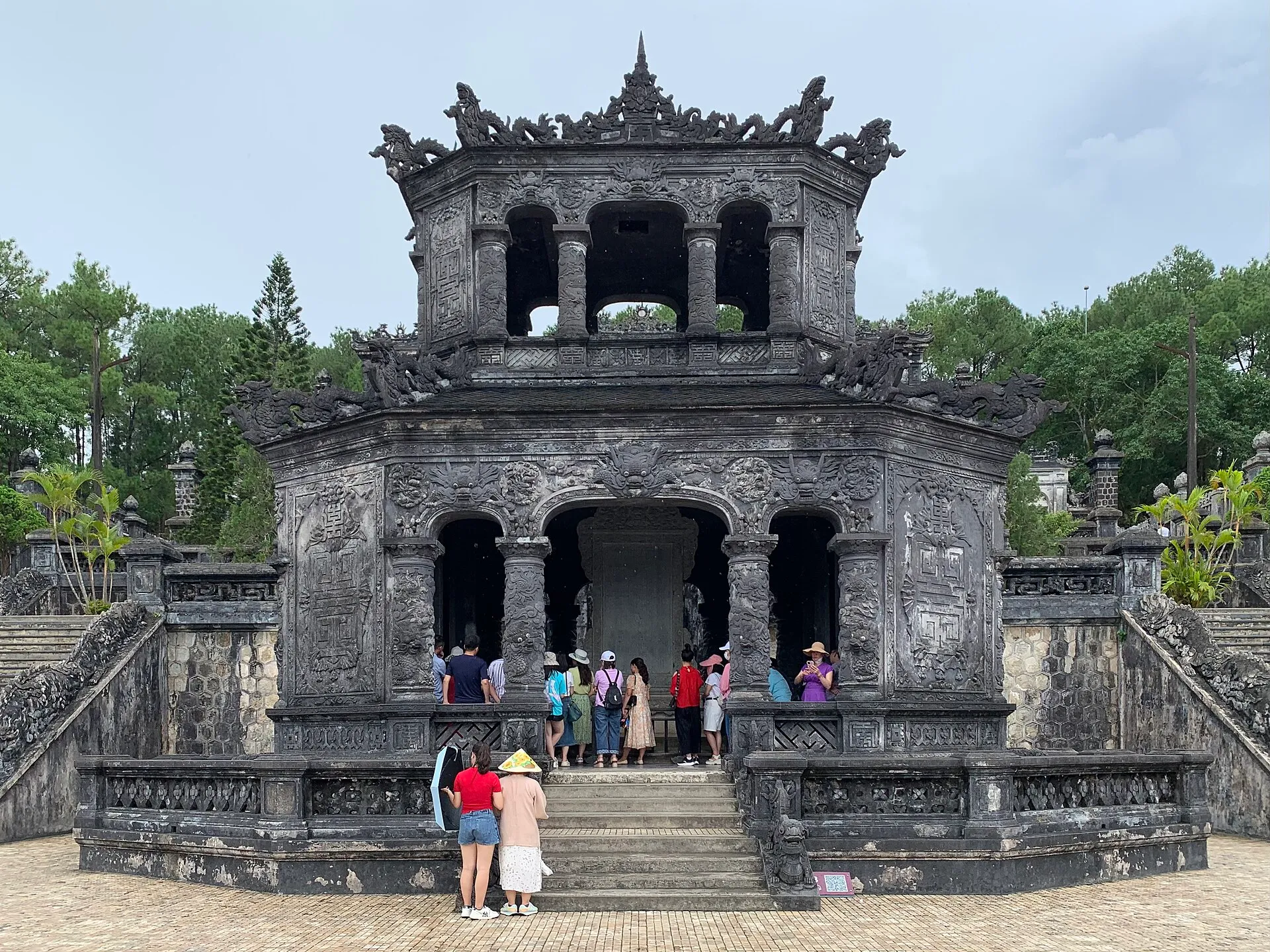
The first thing you notice is the material. Unlike earlier royal tombs, this one is built of reinforced concrete; iron, steel, cement and slate tiles were bought from France, porcelain and glass from China and Japan. On those walls, Roman, Gothic, Hindu and Buddhist architecture stand side by side, not entirely comfortably, but true to a man of his time: Khải Định had travelled to France and wanted his tomb to speak both languages.
You pass the three-arched gate and a courtyard of mandarin, elephant and horse statues, then climb to the Thiên Định Palace — the highest part and the most carefully made. It has five connected sections: the Tả and Hữu Trực rooms for the tomb guards; the Khải Thành hall in front, holding the altar and the emperor's portrait; the Bửu án, bronze statue and grave in the middle; and the innermost shrine with his tablet. The whole tomb measures only about 117 by 48.5 metres, smaller than many others.
But once you step into the three central bays, size stops mattering. Walls, columns and ceiling are densely inlaid with porcelain and coloured glass. Above the bronze statue — cast in France in 1920 — hangs a one-tonne canopy whose curves look almost like velvet. On the ceiling of the three central bays are three “nine dragons hidden in clouds” panels by the artisan Phan Văn Tánh, considered among the largest ceiling paintings in Vietnam. Stand still for a moment in that narrow room: everything glitters, everything is packed tight, and everything is silent.
On the way out, look back at the steps. An emperor prepared his resting place with the newest materials he knew, and left behind a room that reveals more pieces the longer you look. Khải Định's tomb is not large; it simply refuses to let your eyes go.
What to look for
- The 127 steps up to the Thiên Định Palace, seen from the courtyard below.
- Walls, columns and ceiling of the three central bays inlaid with porcelain and coloured glass.
- The one-tonne canopy above the bronze statue, cast in France in 1920.
- Three “nine dragons hidden in clouds” panels on the ceiling by the artisan Phan Văn Tánh.
Getting there & etiquette
- Go early or after 3pm; there is little shade and the steps are slippery in rain.
- Allow about 45–60 minutes; do not skip the three central bays of the Thiên Định Palace.
- Dress respectfully around the shrine: shoulders and knees covered.
- Opening hours and tickets change by season — check the official site beforehand.