Thanh Thủy Chánh village, nearly 10 km east of the centre
Thanh Toàn covered bridge
A roofed wooden bridge that is also a bench and a shrine — paid for by a woman in 1776.
The story
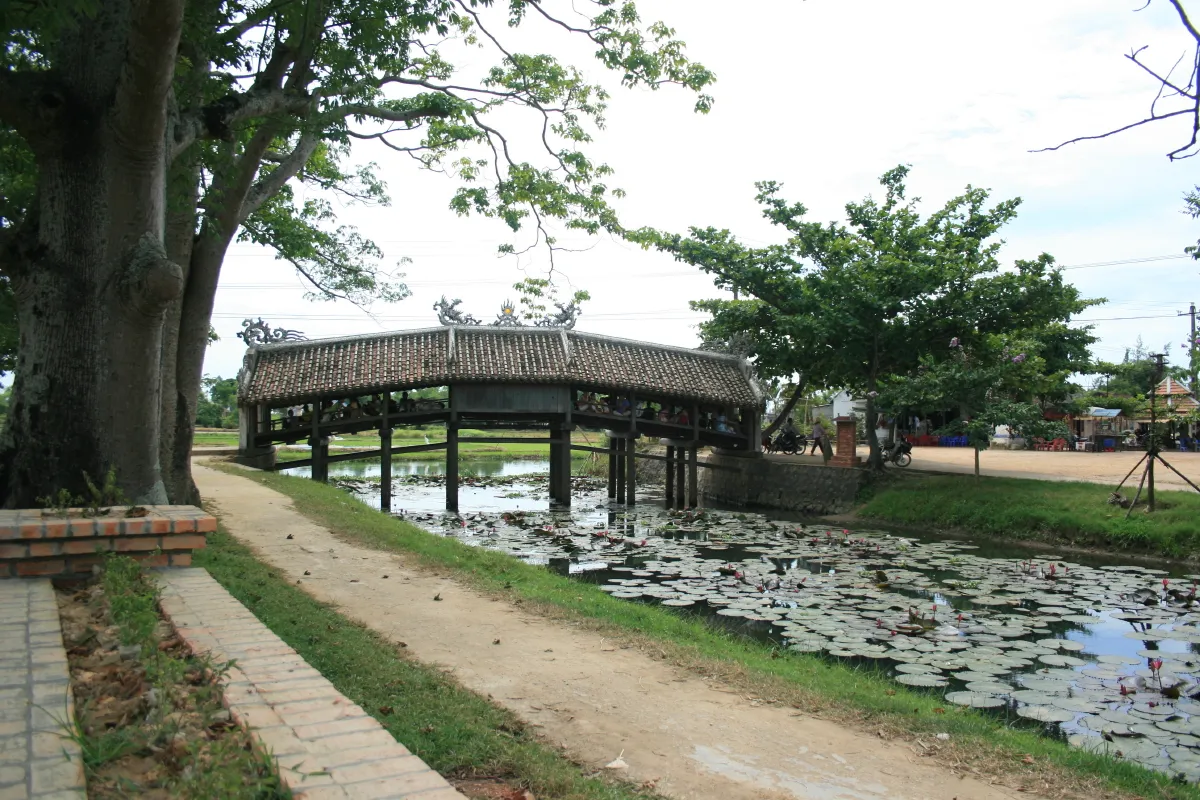
You follow a village road nearly ten kilometres east of central Huế, past rice fields and small ponds, until a tiled roof appears lying across a narrow canal. This is the Thanh Toàn covered bridge: not so much a bridge to cross as a roofed wooden house built over water. Along both sides run wooden benches and railings to lean back against.
The bridge was built in 1776. The woman who paid for it was Trần Thị Đạo, wife of a high official under Emperor Lê Hiển Tông and a native of Thanh Thủy Chánh village. She had no children, so she donated money for a bridge to make the crossing easier for villagers on both banks. In the same year, Lê Hiển Tông issued an edict praising her and exempting the village from several kinds of corvée, so that people would remember her. The bridge follows the “house above, bridge below” pattern: 18.75 metres long, 5.82 metres wide, in seven bays, with a roof of glazed tiles.
The central bay serves as her altar. In 1925 Emperor Khải Định conferred on her the title “Dực Bảo Trung Hưng Linh Phò” and ordered an altar to be set up on the bridge itself. Since then the bridge has been a crossing, a resting place and a small shrine. Sit down on one of the wooden benches and look out at the canal: this is where travellers used to stop, not a spot for a quick photograph.
The bridge has survived storms, floods and war; villagers have contributed money to repair it many times. In 1990 it was recognised as a national architectural monument. During Huế Festivals, the bridge and the village market beside it are chosen to recreate a traditional rural market day, with ploughs, harrows, sickles, winnowing trays and country food.
The lane into the village is narrow, with houses and fields on both sides; a large car will struggle to turn around. Come in the morning, bring water, and allow at least half an hour to sit on the bridge. It is not a grand monument; it does one job well — sheltering people from rain and sun and giving travellers somewhere to sit. Two hundred years later, that job still matters.
What to look for
- The glazed-tile roof covering the whole bridge, seen from the village approach.
- The two rows of wooden benches and railings along the span — seats for travellers.
- The central bay with Trần Thị Đạo's altar, standing on the bridge itself.
- The “house above, bridge below” structure: one timber frame serving both.
Getting there & etiquette
- The village road is narrow with fields on both sides; a motorbike or small car is easier.
- Go in the morning; midday is hot and there are few shops in the village.
- Keep quiet around the altar in the central bay.
- Hours vary — the bridge is outdoors, but arrive well before dark.